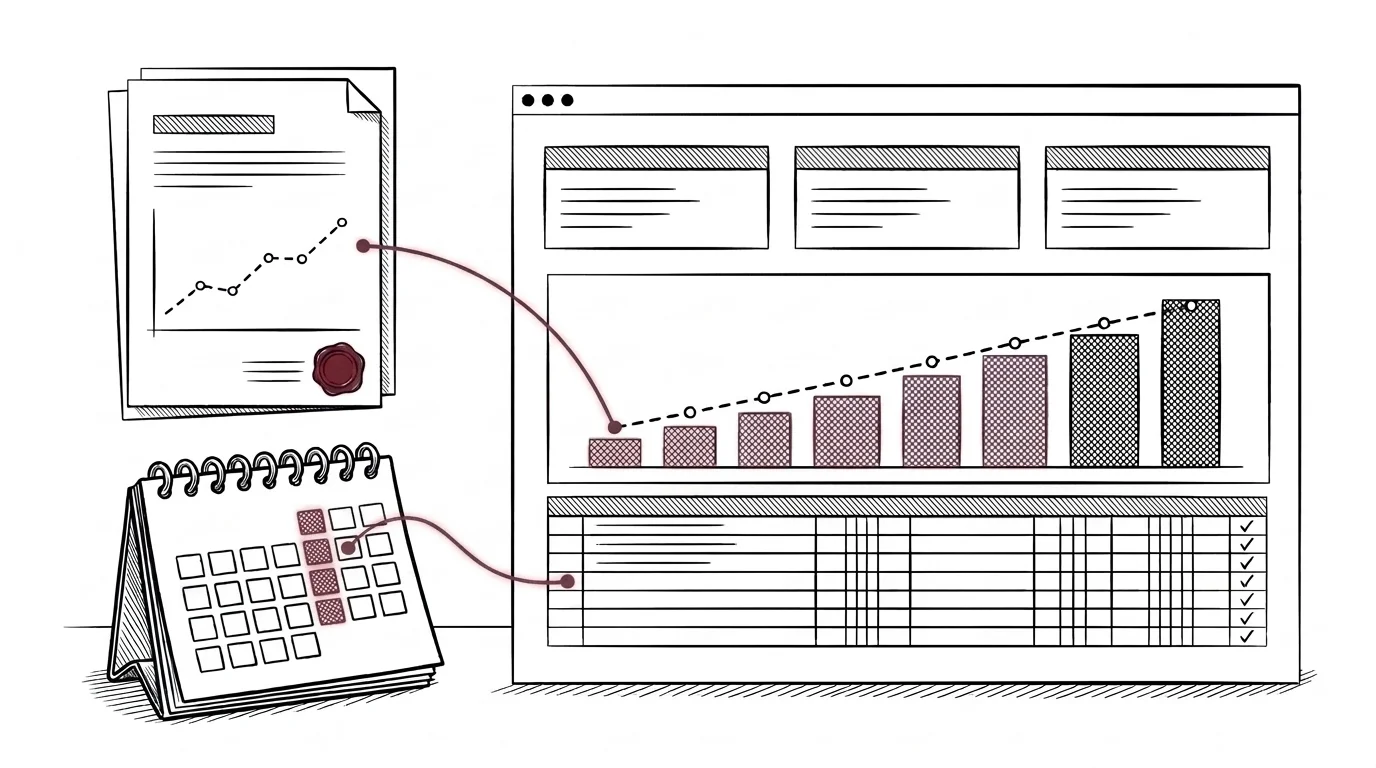
An operating plan is a handful of numbers the company commits to: revenue or ARR by a date, cash at the end of each quarter, a monthly burn limit, a hiring ramp, maybe a burn multiple. It is usually built in a spreadsheet outside the books, presented once, and then quietly edited as the year unfolds.
“We missed our Q1 target relative to the plan, so the question I have for you is, when you miss a quarter (or two or three :)), do you…” (a Y Combinator (YC) founder on the private YC forum)
The same founder asked whether to keep chasing the original number or move it, and what to tell the team once the year-end milestone “feels completely out of reach”. Neither answer works if nobody can see the original plan and today’s results side by side.
Three ways the plan breaks
- The actuals are rebuilt by hand. Every board update means pulling revenue, cash and headcount from the books and pasting them next to the plan.
- The original disappears. A re-forecast overwrites the January numbers. You can say where you are against the current plan, but not against what was approved.
- The plan and the pipeline never meet. The revenue target is in the model, the deals are in the CRM. Whether the open pipeline covers the gap is a separate exercise.
What I saw
At the company I ran, board reporting and revenue collection always took priority, and the systems underneath got deprioritized. Our model had five owners over the years, and every plan-versus-actual started with someone rebuilding the actuals.
 Pelle BrændgaardFounder, Economico
One plan, many targets, every version kept
Treat the plan as a set of targets that share a label:
- One target per number. ARR of at least $1.2M by December, read to date. Cash of at least a stated amount at each quarter end. Net burn at most a stated amount each month. People in place at least a stated number. Each is measured by a query over the books, so the actual is never typed in.
- A shared plan label. All of them carry
plan = 2027-annual, so they are listed and read together. - Revisions are new versions. When you re-forecast in June, past months keep the numbers you agreed and future months get the new ones. Every version records who changed it, when and why.
- Two reads, not two spreadsheets. Read the plan as it was approved in January and as it stands today, against the same actuals.
A burn multiple works the same way, from a ready recipe: the cap is a number such as 2.0, and the read shows the multiple for each period. For any other ratio, your agent writes the measure and tries it on a real month before you hold the company to it.
How it looks with an agent
In Economico (the business context layer and underlying data model your own agents run, rather than another planning spreadsheet), your agent records the plan as targets from the Economico skill’s recipes (ARR, MRR, recognized revenue, cash balance, net burn, people in place, payroll cost, and won pursuits or won value in a pipeline), labels them with the plan, and keeps them proposed until you confirm the numbers. Before a board meeting you ask for the plan, and it reads every target straight from real accrual books.
 Your agent × Economico
Called 2 Economico tools
Economico
targets · list
✓
9 targets with plan = 2026-q4
Economico
targets · read
✓
One read per target, October and NovemberTry it
Prompts for your operating plan
Turn this board-approved plan into proposed targets labelled plan 2027-annual: ARR, quarter-end cash, monthly net burn and headcount.
Lower the ARR target from July on to $900,000 by December, keep the earlier months as approved, and record the reason.
Read the plan as approved in January and as it stands today. Where are we ahead, where are we behind?
To keep the plan-against-actual view for every board meeting, have your agent save it as a custom report with a chart, or read the board pack you stop rebuilding every month.
See targets, founder-led performance management, custom reports and investor reporting.