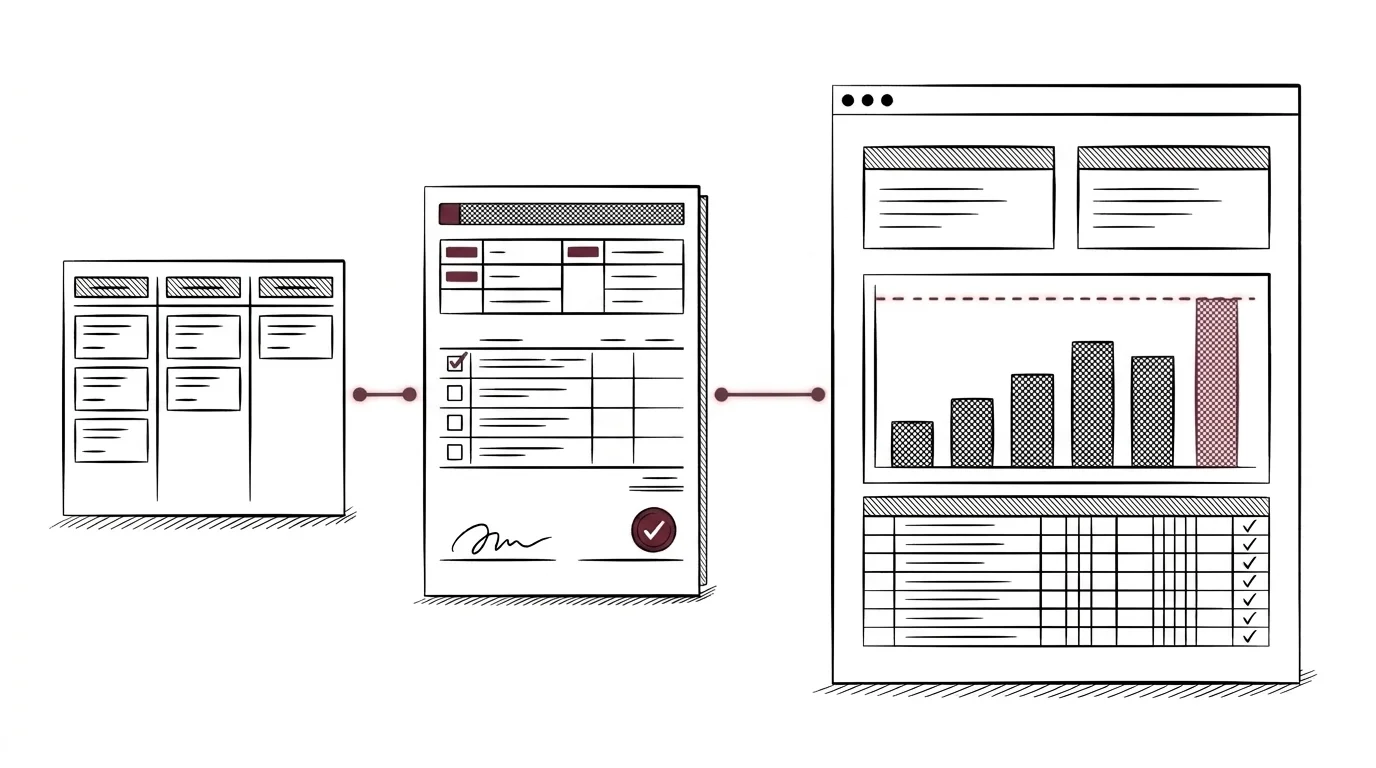
Founder-led sales usually has three records. The CRM holds the deals and their stages. A spreadsheet holds the quarter’s target and, once you hire a salesperson, their quota. The books hold what was actually signed, invoiced and paid. Every week someone lines the three up by hand, and the answer to “are we going to hit the quarter?” depends on who did the lining up.
“Sometimes I still forget to follow up with the high-touch list after they promised to sign up but don’t. I might need to track sales under ‘deals’ instead of ‘people’ or ‘company’ level.” (a Y Combinator (YC) founder on the private YC forum)
Why the CRM number drifts
A CRM counts what someone marked closed. That is often a verbal yes, a signature that has not arrived, or a deal that was amended down after the fact. When a company starts pulling revenue or ARR out of the CRM, the number it reports is the number the salespeople typed, not the number the contracts say.
What I saw
At the company I ran, the pipeline was hard to plan from, and the tool was not the main reason. Each account executive managed it differently and brought a different level of optimism. Deals that looked about to be signed were not, and the larger enterprise deals often had something that made them take longer. So the pipeline itself was difficult to use for running and planning the company.
In Economico the pipeline ties directly into the books, and you can attach much more to each deal. You and your agent can go back and work out what actually happened and where things stand. That is very difficult in a traditional CRM.
 Pelle BrændgaardFounder, Economico
Hold the pipeline, not the spreadsheet, to the number
The fix is to put the target where the deals and the agreements already are:
- One pipeline per motion. Enterprise, self-serve upgrades and partners move differently, so give each its own stages and default weights.
- Won means accepted. A deal counts when the contract it was for is accepted, not when a stage is changed. The contract then drives the invoices and revenue.
- A target per pipeline and period. “At least $60,000 in new annual contract value this quarter”, held by the enterprise pipeline, read from won deals.
- The open pipeline beside the actual, never inside it. The weighted value of deals expected to close in the period tells you whether the gap is covered. It is an estimate, so it should never count toward the target.
A quota for one salesperson is the same thing held by one person. The part that needs a decision is which deals count toward them, for example deals labelled with their name as owner. Splits and commissions are a separate problem.
How it looks with an agent
In Economico (not another rigid SaaS CRM, but the business context layer and underlying data model your own agents build custom sales and ops workflows on top of real accrual books), your agent defines the pipelines, opens each deal with its expected value, close date and labels such as owner or segment, and links it to the contract when it is drafted. It records the quarter’s target against a won-value measure from the Economico skill. When you ask where the quarter stands, it reads the target: stated value, actual, gap, and the weighted open pipeline closing in the period.
- Open 10% 2 deals, no value or close date yet
- Qualified 50% none
- Proposed 80% 1 deal, $24,000
- Actual, from the books
- $12,000
- Weighted open, not counted
- $19,200
In progress. $48,000 to go, and the open pipeline covers $19,200 of it.
 Your agent × Economico
Called 3 Economico tools
Economico
targets · read
✓
Q4 enterprise won value: in progress
Economico
reports · pipeline
✓
Open enterprise deals by stage
Economico
report_sql
✓
Open deals grouped by the owner labelTry it
Prompts for founder-led sales
Propose a target of at least $60,000 in new annual contract value this quarter for the enterprise pipeline.
Does the weighted open pipeline closing this quarter cover what is left of the target? Tell me what you assumed.
Which open deals have no expected value or close date?
See pipelines, targets, and how they combine in founder-led performance management.