Learn
Your investors value recurring revenue. Your books don't see it
Contracted recurring revenue drives your valuation and your fundraise. Your bookkeeper is trained to report tax-return revenue. So founders end up gluing Stripe and HubSpot together in a spreadsheet.
Your investors love recurring revenue — and so should you.
Recurring revenue is contracted revenue: money customers have agreed to pay you, with a strong chance of coming again and again in the future. Because it is predictable, it raises the valuation of your company and lets you fundraise from a much stronger position. Founders raising with a mix of revenue streams feel that valuation gap immediately:
“The VCs we’re talking to still massively discount transactional revenue.” (seed-stage CEO we interviewed)
So how do you actually get your recurring revenue number?
Two different numbers called revenue
Early on, you might assume you can just ask your bookkeeper or your accountant. In reality, you cannot — not because they are bad at their job, but because they are not trained to deal with recurring revenue.
To an accountant, revenue is what goes on your income statement and your tax return: what you have earned and recognized in a completed period. Recurring revenue (MRR or ARR) is a forward-looking view of your active customer contracts. Both numbers are valid, and both matter. They just answer completely different questions:
- Income-statement revenue tells the tax authority and auditors what you earned during a past month or year.
- Recurring revenue tells you and your investors the run-rate of the contracts your business holds today.
Standard accounting software was built for the first number. It does not understand contract terms, renewal dates, ramp schedules, or annual recurring run-rate. As one founder on Reddit noted:
“We’ve seen the same distinction cause confusion and founders expect accounting software to answer SaaS questions it was never designed for.” (founder on Reddit)
So your books simply do not see the number your investors care about most.
Not every dollar counts as ARR: seven numbers people call revenue
Before you calculate recurring revenue at all, you have to be honest about what kind of revenue you actually have. Y Combinator (YC) puts this bluntly in its guidance to founders on being truthful and precise about revenue: do not mistake one tier for another, and never pitch a weaker number under a stronger name.
Below are Y Combinator’s five commercial tiers — ordered from least impressive to most impressive — followed by the two accounting views your books and bank statement report (GAAP accrual revenue and cash revenue):
| Number | What it actually means | How to say it truthfully |
|---|---|---|
| Non-binding LOIs | A customer signed a Letter of Intent saying they would be willing to pay if the product is built and works later. There is no obligation to pay — only an indication of future pilot interest. | “We have $100K in non-binding LOIs from customers X, Y, and Z.” |
| GMV / GSR | Gross Merchandise Value (or Gross Services Revenue) is the total transaction volume flowing through a marketplace or retailer. It is not your revenue; your revenue is your slice (GMV × take rate). | “Our GMV this month is $100K with a 20% take rate, so our marketplace revenue is $20K monthly.” |
| Bookings / cARR | Contracted ARR: a customer signed a binding contract committing to pay $X per month or year. Much stronger than an LOI, though pilots, opt-out clauses, and “starts billing after deployment” reduce how solid it is. | “We have $100K in contracted ARR (cARR), mostly in pilots that start billing once we're fully deployed.” |
| Transactional revenue & run rate | One-off product or usage sales over a period, optionally annualized (monthly revenue × 12). Never abbreviate Annual Revenue Run Rate to ARR — it is not recurring. | “We make $50K per month in transactional revenue” or “about $600K in annual revenue run rate.” |
| MRR / ARR | Monthly or Annual Recurring Revenue: revenue actually invoiced and paid regularly under recurring monthly or annual contracts. The most prized commercial tier — and the only one that earns the MRR or ARR label. | “We make $50K MRR (monthly recurring revenue).” |
| GAAP (Accrual Revenue) | Revenue earned and recognized on your income statement over the period you actually deliver the service, regardless of when cash arrives. A $12K annual plan paid upfront is $1K/month of GAAP revenue; the rest sits on the balance sheet as deferred revenue. | “We recognized $33K in GAAP accrual revenue this month, with $95K in deferred revenue still to be earned.” |
| Cash Revenue | Cash actually collected in your bank account or wallet during the period. Essential for runway and treasury, but noisy for growth — annual prepays make one month look huge and late invoices make the next look empty. | “We collected $68K in cash this month, including two annual prepays.” |
Our take: why founders blur these numbers
In my experience, founders rarely mix these numbers up because they want to mislead anyone. They mix them up because fundraising is painful — and because their tools make the drift effortless.
When runway is tightening and you are fighting to move forward and raise money to play another day, you feel the pull to put the strongest possible number in front of investors. You know how hard your team is working. A pilot feels as good as closed, a big transactional month hits Stripe, three signed contracts are waiting on deployment — and you desperately want investors to see how well the business is actually doing. The stakes feel asymmetrical because they are:
“You don’t have that many companies in your lifetime. So you can’t just roll the dice like a thousand times like GPs.” (seed-stage founder we interviewed)
Your tools quietly encourage that impulse. LOIs, signed pilots, and live contracts sit side by side in the same CRM pipeline. One-off onboarding fees, transactional usage, and recurring subscriptions land in the same Stripe payout. Pass-through marketplace volume lands in the same bank account as your net take rate. Late at night before a partner meeting, it is all too easy to export three CSVs into a spreadsheet, sum them up, and convince yourself the bottom row is “ARR.”
And underneath the optimism sits the quieter dread every fundraising founder knows:
“When I was a founder, sending investor updates was scary. We feared scrutiny over our numbers.” (former founder on X)
The painful part is that blurring those tiers hurts you most right when you need trust the most: the moment diligence starts and an investor compares the deck against your contracts and bank statements. Keeping those seven numbers straight should not depend on willpower when you are stressed and trying to close a round — it is a data-model problem. Pipeline intentions (LOIs) stay in your CRM and off your books. Everything past a signature — committed bookings, live recurring obligations, one-off or pass-through fees, GAAP accrual recognition, and cash collected — is a different view of the same signed contracts and bank movements. When your books record contract structure alongside ledger entries, those views stay separate automatically, so you can show investors every honest sign of momentum without ever having to blur one number into another.
How founders end up with multiple sources of truth
Before you have a dedicated finance hire — and often long after — the gap gets filled the same way almost everywhere: a spreadsheet.
Most founders I know, myself included during nearly seven years as CEO of a venture-backed company, start by exporting data from Stripe, exporting deals from HubSpot, pulling in signed order forms, and manually tweaking formulas to calculate ARR, renewals, and churn.
“Every month same routine — export CSV from Stripe, paste into Excel, spend 2 hours figuring out MRR, churn, failed payments.” (founder on Reddit)
Once your pricing goes beyond a single flat subscription — seats plus usage plus an annual commitment — standard billing dashboards stop fitting too:
“There’s like subscription based revenue and there’s usage based revenue and also seat based revenue… nothing was really cutting it, like even as we try to dig into like unit economics.” (an Economico customer)
The moment you rebuild recurring revenue in a separate sheet, you have multiple sources of truth. Your accounting books say one thing for the tax return. Your spreadsheet says another thing for investors. A billing export says a third. Worse, without a single record underneath, different teams quietly start using different definitions:
“Questions like ‘when does recurring revenue start?’, ‘what is an active client?’, and ‘what counts as churn?’ were being answered differently by different teams.” (from the internal record of a venture-backed company I ran)
Every month someone has to reconcile why the numbers disagree, and every time you add a custom deal, a mid-term upgrade, or an annual prepay, the spreadsheet gets harder to trust. It does not scale.
How to keep recurring revenue and accounting revenue from drifting apart
The fix starts upstream of both your accounting package and your investor spreadsheet. Another founder we interviewed put it in five words:
“The atomic unit is the contract.” (startup CEO we interviewed)
The friction shows up the moment a signed agreement has to be translated by hand into an accounting system that was never designed around contracts:
“When you give it to a finance person, they can’t translate it. Into something that goes into the system.” (same CEO, in an interview)
Whether you use dedicated software or keep your own structured register, three rules stop the two numbers from drifting apart:
- Record the signed contract once as structured terms. Capture the start date, term length, renewal rules, and which lines are recurring versus one-off onboarding or services before anyone issues an invoice.
- Lock down one definition of ARR. Decide once when recurring revenue starts (contract start date, not signature date), annualize multi-year contracts instead of counting full term value, and exclude one-off fees.
- Derive all three views from the same contract events. Cash collected (bank), recognized accrual revenue (income statement), and active recurring run-rate (ARR) will almost always differ in any given month — especially on annual upfront deals. If you want to see how recognized revenue diverges from cash on a single annual contract, try flipping between cash and accrual yourself. Keeping the contract underneath all three means you can always explain the exact bridge between them.
How founders do this without Economico
You do not need a new finance stack on day one to be rigorous about this. Most early teams solve it in one of two ways:
- A contract-backed spreadsheet reconciled monthly against CRM and Stripe. Keep one master tab where every row is a signed customer contract — start date, end date, recurring amount, one-off fees split out, and a flag for pilots or opt-outs. Once a month, export your closed-won deals from your CRM and your active subscriptions and invoices from Stripe, reconcile any upgrades or churn by hand, and tie the recognized column back to your accountant’s P&L. Under 15–20 customers, this works well and forces you to know every deal. It starts breaking the moment mid-term upgrades, custom order forms, usage tiers, and annual prepays turn that monthly reconciliation into a half-day debugging project.
- Stripe plus a SaaS metrics layer (such as ChartMogul or Baremetrics). If 100% of your revenue is standard self-serve subscriptions billed through Stripe, a metrics tool gives you clean MRR, ARR, and churn out of the box. The gap shows up as soon as enterprise order forms, wire payments, or custom hybrid pricing live outside Stripe — then you are back to gluing exports together in a spreadsheet.
“Book Acme Robotics' signed $36,000 annual order form starting Oct 1, billed annually.”
- Customer
- Acme Robotics
- Term
- 12 months · auto-renew
- Committed ARR
- $36,000 / year
- recurring · $3,000 / month recognized
- billed annually upfront · net 30
- $33,000 deferred after month one
Booking the contract once in Economico
Solving this gap — for the issues I ran into myself and watched my CEO friends hit over and over — is why I built Economico.
When your agent records each customer contract with its term, renewal, and pricing rules in one ledger, both your SaaS metrics for investor reporting and your accrual income statement read from those exact same books. You stop exporting CSVs between Stripe, HubSpot, and a fragile spreadsheet just to figure out what your recurring revenue is today:
 Your agent × Economico
Called 4 Economico tools
Economico
commands · contracts.create
✓
Acme Robotics · $36,000/yr · 12-month term
Economico
commands · contracts.record
✓
Annual invoice $36,000 · $3,000 earned in Oct · $33,000 deferred
Economico
reports · saas_metrics
✓
ARR $420,000 across 14 active contracts · 3 renewals in 90 days
Economico
reports · income_statement
✓
October recognized revenue $33,100Recorded Acme Robotics’ order form with the signed PDF attached.
Both numbers now come from the same 14 active contracts:
- ARR: $420,000 (up $36,000 from this contract; 3 contracts renew in the next 90 days)
- October recognized revenue: $33,100 ($3,000 recognized from Acme’s first month; $33,000 sits in deferred revenue for the remaining 11 months)
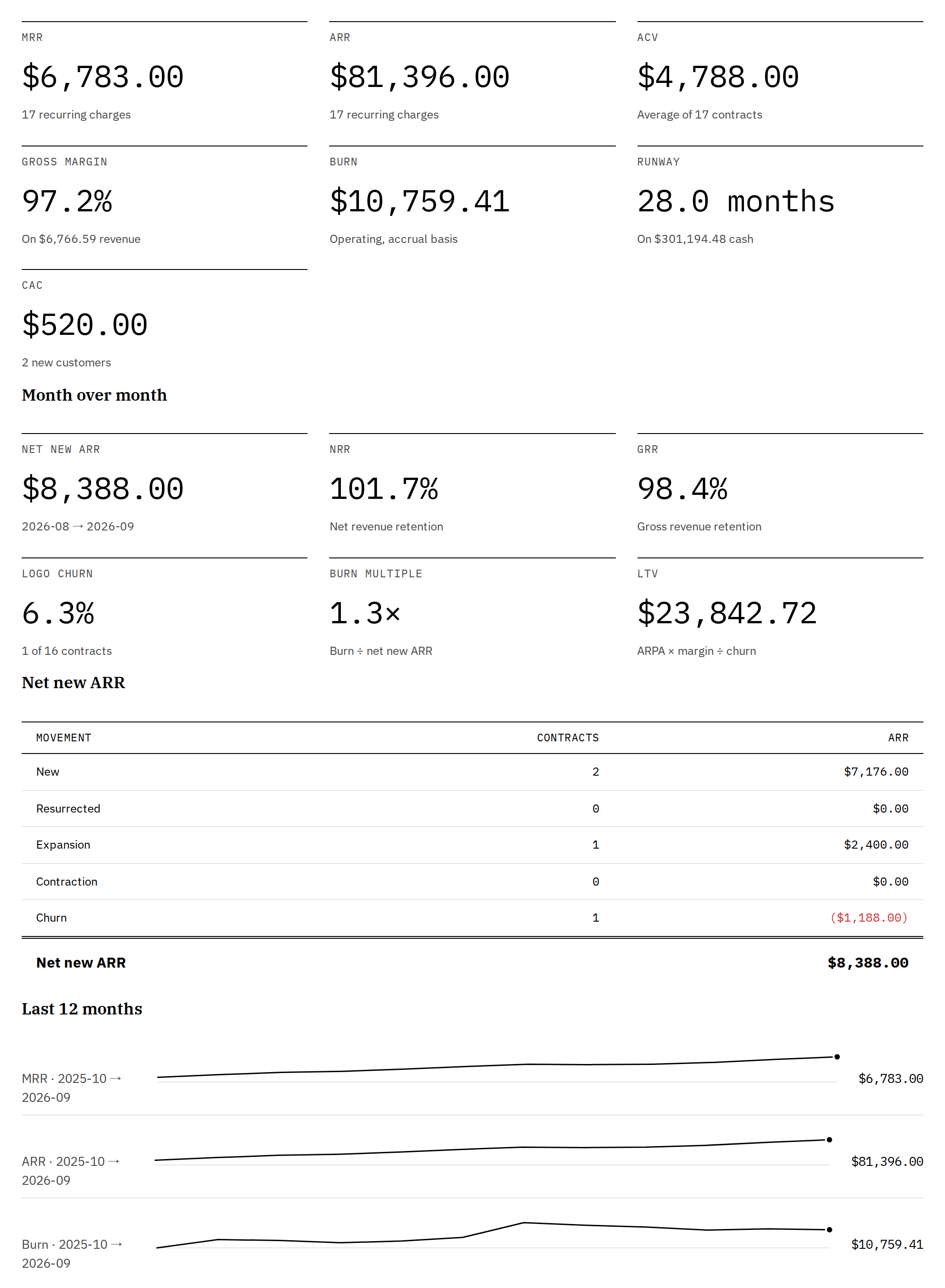
Book the contract once. Know both numbers, and know why they agree.
Try it
Once the activity is recorded, ask for the basis.
What is our ARR right now, and how much revenue do we recognize for this month?
Which customer contracts renew in the next 90 days, and what is their annual value?
Why does our recognized revenue this month differ from our active MRR?