Learn
We nearly ran out of money
Three years into my prior startup, sales were strong, sales cycles were down, and revenue looked great. Then I walked into a board meeting and our runway was dangerously low. Nobody had been recording whether customers were paying their invoices.
Three years into my prior startup, we nearly ran out of money.
I could not believe it. I had a board meeting, and our runway was so low that I was genuinely scared. Worse, I could not make sense of it. On paper, the business was working. Sales were strong. Customers loved the product. Our sales cycles had come down. Our revenue numbers looked great — well, never great, because as a founder you always want more, but clearly moving in the right direction.
None of that matched the bank balance.
The basic thing nobody was recording
When I started digging into why cash was so tight, the answer sounded almost too basic to be true: the people who should have been tracking it were not actually recording whether sent invoices were being paid.
Customers had signed contracts. Invoices had gone out. Revenue was showing up in our reporting. Yet in reality, our customers owed us way more money than we had sitting in the bank. Going into board meetings looked like this:
“First thing in the morning, could I get an itemized list of accounts receivable with amounts and invoice dates please. Prior to the board meeting I need an overview of how bad it is.” (from the internal record of a venture-backed company I ran)
I had to light a fire under the team to chase down what was owed. We got collections under control and we were okay. Even so, it was deeply unnerving. I felt bad in front of my board, and I felt bad for myself.
It turns out this happens far more often than founders admit publicly. In interviews and private founder threads, the exact same blind spot shows up over and over:
“We’re thinking like, oh, everyone’s keeping track of what they owe us, and then we go to like collect it, it’ll be no problem. So like it doesn’t quite work that way.” (startup CEO we interviewed)
“Them not paying us slipped off our radar until now.” (Y Combinator founder on YC’s private founder forum, four months into an annual contract)
“If a customer doesn’t pay, it can wipe out our earnings from every other customer for the next few months or more.” (Y Combinator founder on YC’s private founder forum)
Why it is so easy to miss
It is tempting to blame that on carelessness, but the truth is more structural. The systems early startups stitch together are not built to make this easy.
Your signed contract lives in one tool or a folder of PDFs. Your invoices go out from a billing system. Payments land in a bank account or wallet with cryptic wire references or under a parent company’s name. An early-stage finance team spends its time duct-taping those conflicting systems together, and in the seam between them, unpaid invoices and unmatched payments are remarkably easy to miss.
Founders running manual billing describe the same drift:
“It’s just too easy to let it slip when it’s something you need to follow up on manually.” (Y Combinator founder on YC’s private founder forum)
“It was ad hoc deals and a spreadsheet with when deliveries went out and when the money would come in, which fifty percent of the time was late.” (startup cofounder we interviewed)
Some founders get burned badly enough that they start pricing receivables risk into their margins just to survive it:
“I’ve like built in this little bit of a margin to basically create like this little bit of self insurance against the accounts receivable risk.” (seed-stage CEO we interviewed)
Revenue keeps climbing on the income statement because invoices are being issued. Meanwhile, cash quietly falls behind.
Understand your balance sheet before it forces you to
I was CEO of a venture-backed startup for nearly seven years, and that moment left a mark. Most founders spend all their energy looking at the income statement — revenue, growth, maybe burn — and treat the balance sheet as accountant trivia.
Here is the lesson I took away: you need to understand what a balance sheet is, or your balance sheet will forcibly make you understand what it is, the way mine did.
The gap between “we earned it” and “we have the cash” lives on the balance sheet as accounts receivable. Until the money actually lands, revenue is just a promise.
- Invoice sent — revenue bookedSep 2
- Wire arrivesOct 18
If receivables keep growing faster than cash arrives, a business that looks healthy on its income statement can still run straight into a cash wall. That is the same trap behind why burn rate and runway are so easy to misread.
How to stop unpaid invoices from ambushing your runway
Fixing this does not require a collections department. It requires four boring habits that close the gap between sending an invoice and seeing cash clear:
- Read accounts receivable beside your bank balance every week. Never look at revenue without checking how much of it is still sitting uncollected. If AR is growing faster than revenue, you have a cash problem forming right now.
- Match every incoming payment to a specific invoice the week it lands. Do not leave wire transfers, partial payments, or parent-company payouts sitting unmatched until month-end close. Unallocated cash hides who still owes you — and stops you from accidentally dunning a customer who already paid.
- Set clear aging triggers (15, 30, and 45 days overdue). Waiting until someone remembers means invoices silently age four months. Review an aging list every Monday so follow-ups happen while the invoice is still fresh.
- Never celebrate booked deals — or pay commissions — before verifying payment. Collections discipline has to be a system, not an emergency campaign you run once a year before a board meeting.
How founders do this without Economico
Before you have dedicated tooling, two lightweight workflows catch almost every missed invoice:
- A Monday-morning invoice-to-bank spreadsheet. Log every invoice you send in one shared sheet (customer, invoice number, amount, due date, status). Every Monday, open your bank account, manually match incoming wires and ACH transfers against the open rows, and send a short follow-up on anything past 15 or 30 days. It is boring and manual — and it works reliably until deal volume or partial/multi-invoice wires outgrow a spreadsheet.
- Billing-tool aging plus manual wire reconciliation. If most customers pay by card or ACH through Stripe Invoicing or a similar tool, automatic payment matching handles that slice cleanly. Just do not assume the dashboard covers your enterprise wire customers — those still have to be matched back from bank statements by hand every week.
- Drafted Sep 1
- Sent Sep 2
- Overdue Oct 2
- Paid Oct 18
Running your weekly receivables check in Economico
Keeping invoices and payments in one record is a big part of why I founded Economico. Economico does not pull your bank feed automatically or email dunning reminders to customers on its own — you stay in control of customer communication and money movement. What it gives you is one ledger where every invoice and completed payment tie together, with unmatched cash held visibly against each bank or wallet account and email alerts sent to you when an invoice passes its due date.
Every Monday, your agent can check who still owes you and apply any new wires directly against the invoices they settled:
 Your agent × Economico
Called 3 Economico tools
Economico
reports · aging
✓
2 overdue invoices · $26,500 open
Economico
commands · payments.record
✓
$8,500 wire recorded in Mercury Checking
Economico
commands · payments.allocate
✓
Applied to Northwind Labs INV-014 · balance $0Applied Northwind Labs’ $8,500 payment to INV-014 (now paid in full).
One overdue invoice remains open:
- Acme Robotics — $18,000 (
INV-011, 34 days overdue, backed by their Sep 2 order form)
Accounts receivable is now $18,000, and cash is up $8,500 with $0 unapplied.
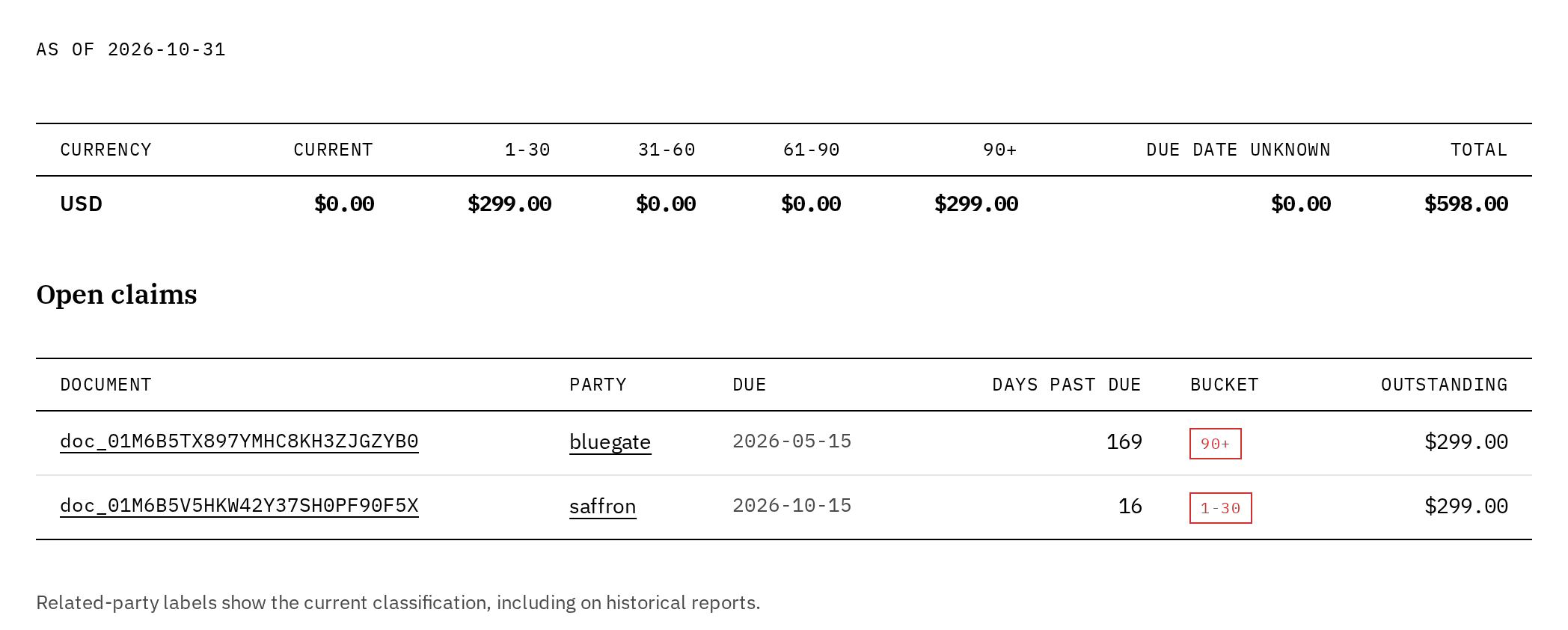
Go founder mode on your finances. Know what you sold, know who has paid, and know what is sitting on your balance sheet before a board meeting forces the conversation.
Try it
Once the activity is recorded, ask for the basis.
Who hasn't paid us yet, and how many days overdue is each invoice?
Which customer payments landed this month, and is any cash still unapplied?
Compare our cash in the bank with our total accounts receivable right now.