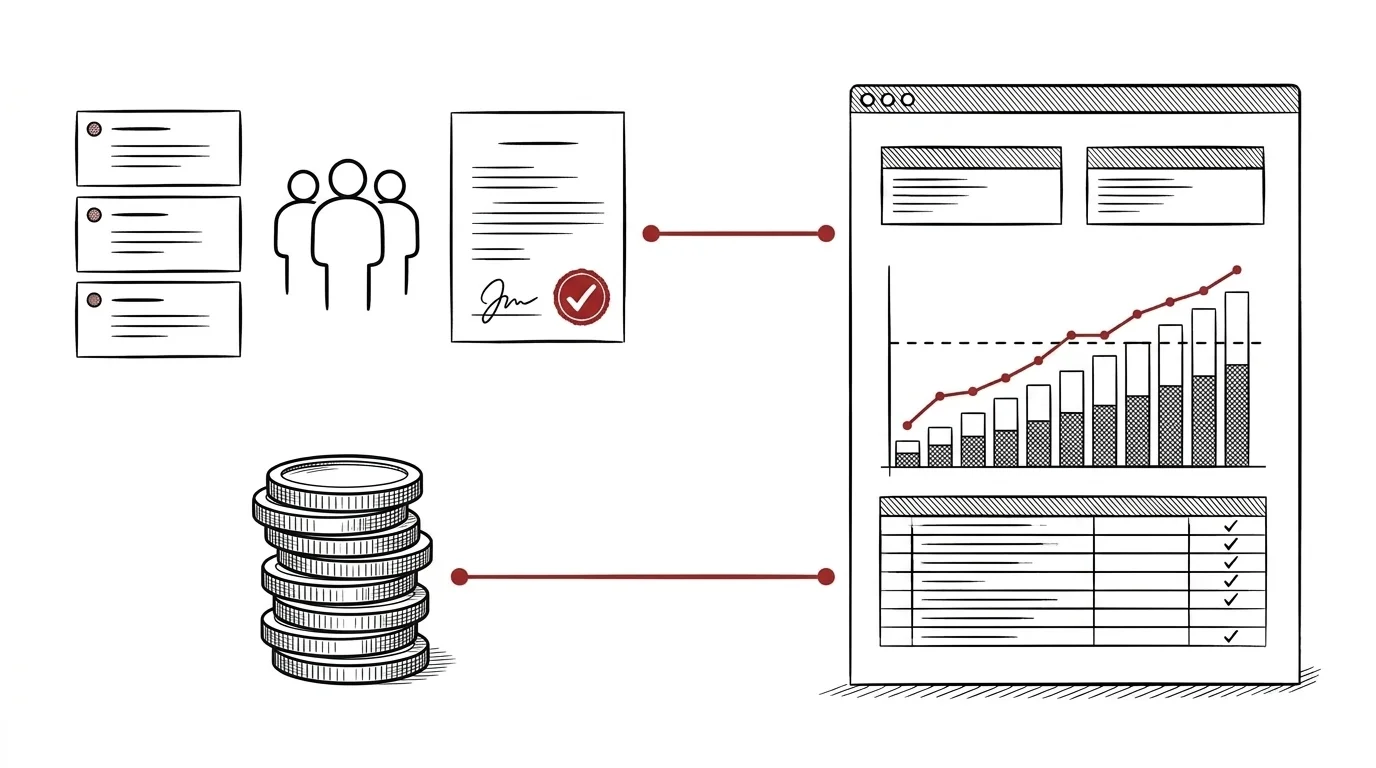
The hiring plan is a row in the operating model: two engineers in Q1, a salesperson in Q2, a designer when the round closes. Candidates are tracked in a hiring tool or a shared doc. Offers are signed in email. The people who joined show up in payroll, an employer of record or a contractor invoice. When the board asks how hiring is going against plan, someone counts heads by hand and hopes the start dates line up.
“I hired too fast, too early. The company was not ready to scale yet.” (a Y Combinator (YC) founder on the private YC forum)
“When I finally ran the numbers, I had 4.5 months left. Not the 8+ I’d been assuming. I’d been making hiring decisions, signing annual contracts, and spinning up paid acquisition, all based on vibes.” (a founder on Indie Hackers)
Two kinds of hiring target
Founders usually have both:
- A one-off hire. One staff engineer by June. The question is whether the pursuit for that role is moving, and when it is filled.
- A ramp. Three sales hires a month for the next six months. The question is whether each month met its number, and whether the open candidates cover the next one.
Both sit next to the money: how many people are in place, and what they cost. A hiring plan that is on track while payroll runs over budget is not on track.
Hold the hiring pipeline to the plan
- A hiring pipeline with your stages. Sourced, interviewed, offer, each with a default weight. Separate pipelines for engineering and sales if they move differently.
- A hire is won when the employment is recorded. Not when the offer is sent: when the employment arrangement is recorded, whether direct, through an employer of record or a PEO.
- A target per period. At least three hires a month from January to June, held by the sales hiring pipeline, with the weighted open candidates beside the actual.
- Company targets beside it. People in place at the end of each month, and payroll cost at most a stated amount, read from what payroll and providers actually billed.
How it looks with an agent
In Economico (the underlying business data model your own agents run, rather than another standalone hiring tracker), your agent defines the hiring pipeline, opens a pursuit per candidate, moves them as interviews happen, and links each hire to the employment arrangement when it is recorded. Targets read from the Economico skill’s recipes: pursuits won in a pipeline, people in place and payroll cost, all on top of the same real accrual books.
- Sourced 10% none
- Interviewed 40% 1 candidate
- Offer 80% 1 candidate
- Actual, from the books
- 0
- Weighted open, not counted
- 1.2 hires
In progress. Covered if the offer is accepted.
 Your agent × Economico
Called 2 Economico tools
Economico
targets · read
✓
Engineering hires: October met, November in progress
Economico
targets · read
✓
Payroll cost at most $20,000: October met, November in progressTry it
Prompts for your hiring plan
Propose a target of one staff engineer hired by June 30, held by the engineering hiring pipeline.
Propose three sales hires a month from January to June, and payroll cost at most $90,000 a month over the same period.
Which roles are behind plan, and which candidates have been at interview longest?
See pipelines, targets and what each employee actually costs.