Learn
Founders trust Claude more than their bookkeeper
When I started Economico, I expected founders to hesitate before letting an agent near their financial details. In founder interviews, I learned the opposite: most already trusted Claude more than their finance team for answers.
When I set out to build Economico, I started with a sensible theory: companies would be worried about letting an agent work with their deepest financial details.
I expected founders to hesitate before trusting an agent with sensitive company data. That was certainly what I had heard from finance people over the years — they were sceptical of it, and they did not necessarily want to trust it. You still see that warning directly from bookkeepers:
“Bookkeeper said not to put financials in Claude or Chat.” (founder on Reddit)
Then I started doing formal interviews with startup founders — and learned the exact opposite.
What founders actually told me
In most cases, the founders I spoke with trusted their Claude more than they trusted their finance team.
That surprised me at first, until I listened closely to what they meant. It was not that they distrusted their finance team or bookkeepers to do their part of the job. Bookkeepers reconcile statements; accountants prepare returns. Still, across founder conversations, the trust gap is real:
“I think a lot of founders don’t trust their finance people.” (startup cofounder we interviewed)
“I don’t want to hear my CFO telling me you can’t do this like you’re doing too much. I need my AI model to tell me that.” (same cofounder, in an interview)
When founders need an answer they can actually act on, they are already turning to Claude to read across emails, contracts, Stripe, and invoices — and finding things no outsourced service catches:
“Stuff that I wouldn’t want to share with the bookkeeper. I was like, that’s Claude, I’ll do everything.” (startup CEO we interviewed)
“Claude found those exceptions and made sure to like account for it properly. I was like, damn, I could not pay someone to do that.” (same CEO, in an interview)
“Claude plugs into the Stripe APIs to update my dashboards and things on revenue and overdue invoices and all that jazz.” (seed-stage CEO we interviewed)
Why I shouldn’t have been surprised
In reality, I should not have been surprised at all — because I was doing the exact same thing myself.
I was the CEO of a venture-backed startup for nearly seven years. Over the last couple of years, I was using Claude to fact-check what my own finance team was telling me, and to pull clear answers out of information that lived all over the place — contracts in one folder, invoices in another, spreadsheets in email threads.
Without Claude, I could not do that myself. I did not have the time to dig through four systems before a meeting, and I did not want to open accounting software built for bookkeepers. With Claude, I could finally verify an answer in minutes.
Keep your CPA. Own your answers.
Nobody is telling you to get rid of your CPA or your accountant. Of course you need them to file your taxes, review tricky treatments, and handle compliance.
What has changed is that you no longer have to accept being a passenger in your own finances. You need your answers. You need control over your answers. You need to know your own numbers.
Why chat threads and DIY databases hit a wall
Pasting CSVs and PDFs into a chat window — or having Claude spin up its own database — is how many technical founders start, and it gets you surprisingly far. Then two limits show up.
First, an agent without a structured ledger underneath has no double-entry guardrail keeping everything balanced over time. Even founders who rebuilt years of books with Claude run into that uncertainty:
“I probably should have spent some time building like a framework for it to like hang things on, because I’m sure it probably struggled without like a system of record behind the scenes.” (startup CEO we interviewed)
“Part of me is like, how accurate is all… I never actually looked at the database myself.” (same CEO, in an interview)
People using agents for personal books arrive at the same separation of roles:
“The agent does the categorization, hledger does the math, so the LLM never touches the numbers.” (user on Reddit)
Second, eventually someone outside the company has to rely on those books — an investor in diligence, an accountant, or an auditor:
“But as soon as you say you built the system yourself, they lock up completely… It’s how do you get the bridge built to an auditor? Because doing the accounts is relatively simple.” (startup CEO we interviewed)
How to give your agent a real system of record
The pattern that works splits the job cleanly between what language models are great at and what accounting systems are built for:
- Let the agent read context, not do the math. Your agent reads messy PDFs, emails, contracts, and bank exports. A deterministic double-entry ledger handles exact amounts, balances, and period rules so the model never invents accounting arithmetic.
- Make every write bounded, idempotent, and append-only. Retries should never duplicate an entry, and mistakes should be fixed with visible reversals rather than silent database edits.
- Keep standing access with your agent, not another vendor. Your agent already reaches the email, files, CRM, and exports you chose to give it. Connect it to your ledger with one scoped, revocable token instead of handing bank and inbox logins to yet another finance dashboard.
- Store every original source document beside the entry. When a CPA, investor, or auditor asks where a balance came from, every number should trace straight back to the signed agreement, invoice, or receipt behind it.
How founders do this without Economico
A growing number of founders already run a version of this setup on their own:
- Claude plus plain-text accounting (
hledgerorbeancount). Technical founders let Claude parse bank CSVs, read PDF invoices, and draft entries while a deterministic plain-text ledger enforces double-entry math in Git. It is clean, transparent, and free — the wall shows up later when you want non-technical cofounders or a CPA to inspect the books, attach immutable source documents, or hand an auditor a system they will not immediately push back on because you built it yourself. - Claude on top of raw exports alongside your bookkeeper. Export Stripe, bank statements, and your bookkeeper’s trial balance into a local folder and ask Claude to cross-check revenue, flag missing invoices, or explain month-over-month swings. That works right away as a fast second opinion without touching your accounting stack, as long as you keep in mind that a chat thread is not a persistent audit trail.
- Your email
- Your CRM
- Your bank
- Your files
- Your email
- Your CRM
- Your bank
- Your files
Your agent reaches your systems with the access you already gave it. Economico holds no key to any of them.
Running your books through your own agent in Economico
That is why I built Economico. Instead of asking you to operate another finance dashboard, your own agents — whether you use Claude, ChatGPT, Codex, or Grok — connect with your own scoped permissions and record straight into one double-entry system of record over MCP or the CLI. Every signed agreement, invoice, payment, and receipt stays stored in the record, so every answer your agent gives you traces straight back to its verifiable source:
 Claude Code × Economico
Called 3 Economico tools
Economico
reports · aging
✓
$26,500 across 2 open invoices
Economico
subjects · get contract
✓
Acme Robotics order form · Northwind Labs MSA
Economico
documents · get
✓
2 immutable signed PDFs verifiedCustomers currently owe $26,500 across two open invoices, each tied to its signed agreement:
- Acme Robotics — $18,000 (backed by the signed order form from Sep 2)
- Northwind Labs — $8,500 (backed by the signed MSA from Jul 14)
Both original PDFs are stored in the ledger and match the billed terms.
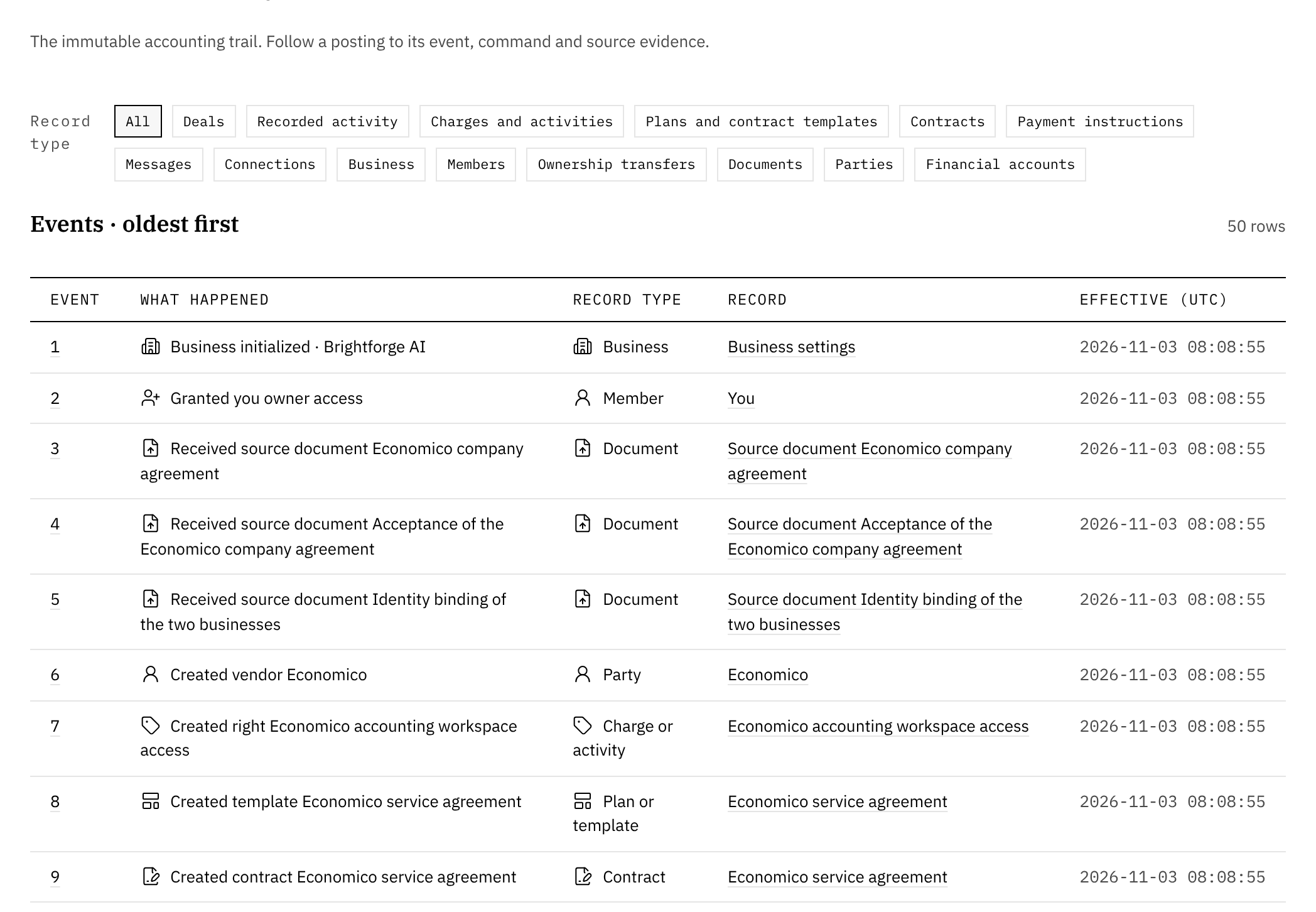
If you want to see what that looks like step by step, walk through running your first week of books with the agent you already use, or connect your agent to a demo company first and ask it a real question.
Try it
Once the activity is recorded, ask for the basis.
How much do customers owe us right now, and which signed agreements back each invoice?
Walk me through this month's revenue and expenses and show the entries behind the biggest lines.
Check that our balance sheet balances and flag any unapplied payments or missing documents.