Targets & dynamic budgets
Targets and dynamic budgets that move with your real books.
Hold a pipeline, a person, a vendor, a customer or the whole company to versioned targets and dynamic budgets — ARR floors, monthly burn, burn multiple, R&D AI spend as a share of Net New Revenue, payroll share of ARR, travel per employee. Every ratio reads live from your real accrual books with the underlying dollars beside it.
Recent changes
Why we built this
At my last company, our operating plan lived in a spreadsheet model that had five different owners over the years. Once we raised a Series A, “the budget” turned into board compliance instead of a tool for running the company. Hiring stalled behind “it’s not within budget” from a static sheet I hadn’t written, and even agreeing with the board to hit milestones before hiring broke in spreadsheets. Putting versioned targets and dynamic budgets directly over real accrual books means the rules move automatically with revenue and headcount, and you see where you stand in week three instead of two hours before the board meeting.
 Pelle BrændgaardFounder, Economico
Static budgets go stale the day you approve them
Compliance-focused accounting software closes weeks after month-end and knows nothing about your operating plan. So targets and budgets end up in a January spreadsheet, and checking them means rebuilding actuals by hand — exporting deals, counting headcount, pulling revenue and bills from the books, and pasting them beside frozen columns. Worse, static budgets break the moment reality moves: hire two engineers and your travel cap is wrong; double Net New Revenue and your R&D token cap still reflects last quarter's guess; re-forecast mid-year and the original board baseline disappears.
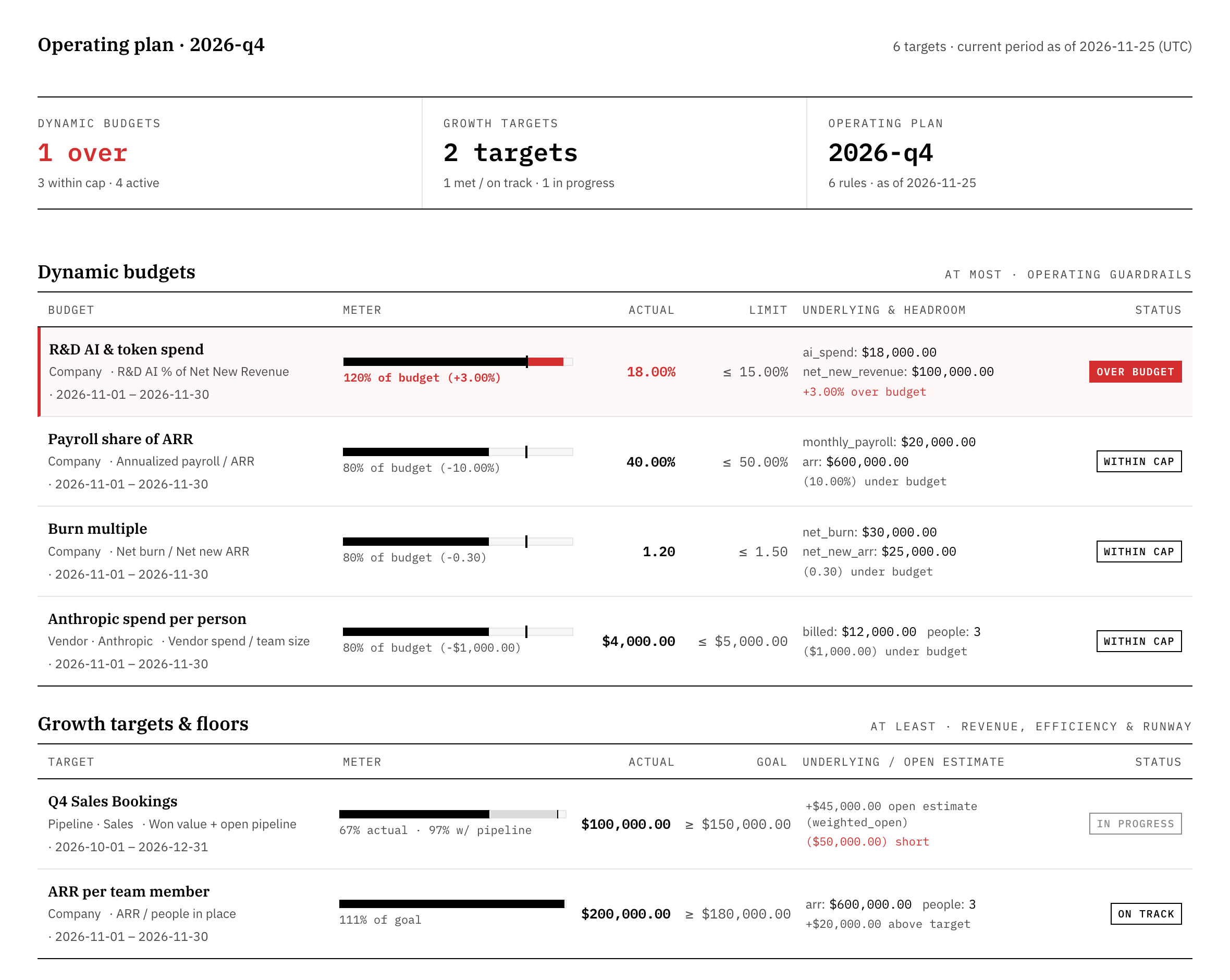
Targets, budgets and quotas in one operating plan
In Economico, a target pins one SQL measure version and one holder: the company, a pipeline, or any party in your books (a person for an individual quota, a vendor for a spend cap, or a key customer account for an expansion goal). A budget is simply an "at most" target — either a static cap or a dynamic operating rate:
- Static cash & category caps: monthly net burn at most $50,000, or quarterly travel at most $10,000.
- Revenue-linked variable budgets: R&D AI & token spend at most 15% of Net New Revenue, or payroll at most 50% of ARR.
- Efficiency guardrails: burn multiple at most 1.5×, or ARR per team member at least $200,000.
- Headcount-scaled pools & vendor caps: travel at most $1,000 per employee, or Anthropic spend at most $5,000 per person — scaling automatically when your team grows.
- Growth targets, quotas & key accounts: Q4 sales bookings held by the sales pipeline or an account executive, plus expansion revenue targets held by a specific customer party.
Group them under one shared plan label and they appear together across your operating plan, company overview, pipeline boards and individual vendor, people and customer pages — without ever posting to any ledger or blocking real expenses.
Every ratio shows the real dollars underneath
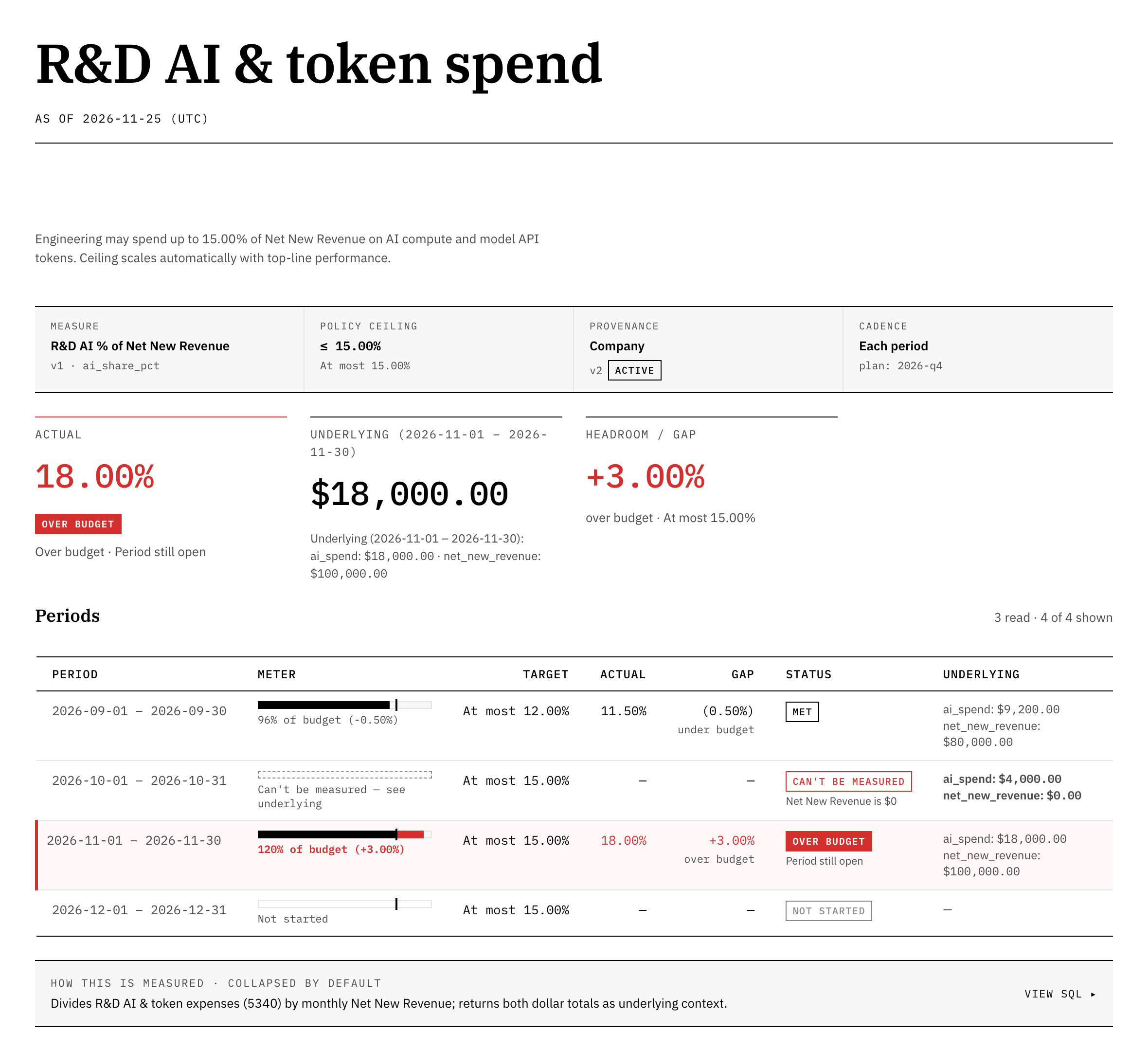
A bare percentage hides reality. Knowing R&D token spend hit 18.00% of Net New Revenue does not tell you whether you spent $18,000 on $100,000 of new revenue or $180 on $1,000 — and in a month with $0 Net New Revenue, a pure ratio cannot be divided at all.
Every target read runs one read-only SQL measure and returns both the compared figure (formatted natively as currency, count, scaled ratio or percent) and the measure's unstated supporting columns as underlying context — with zero extra queries. Even in a zero-revenue month marked Can't be measured, the real dollar spend stays right in front of you. When an active budget crosses its limit before period end, the workspace flags it immediately as Over budget rather than quietly marking it in progress.
Measures: 22 tested recipes, or write your own
Every target runs on a named, versioned, read-only SQL measure over your underlying business data model. Your agent can start from 22 tested recipes in the Economico skill — covering pursuits won, won value with weighted open-pipeline coverage, people in place, payroll cost, ARR, MRR, recognized revenue, cash balance, monthly net burn, burn multiple, travel spend, travel per employee, R&D AI spend as a percentage of Net New Revenue, payroll share of ARR, ARR per team member, per-vendor spend per employee, cash runway in months, and key-account customer revenue — or write a custom measure for the exact rule you manage by and test it against a real window before saving.
 Your agent × Economico
Called 3 Economico tools
Economico
targets · list
✓
Active targets with plan = 2026-q4
Economico
targets · read
✓
R&D AI & token spend (18.00% vs <= 15.00%)
Economico
targets · read
✓
Payroll share of ARR (40.00% vs <= 50.00%)Put targets and budgets straight into investor updates
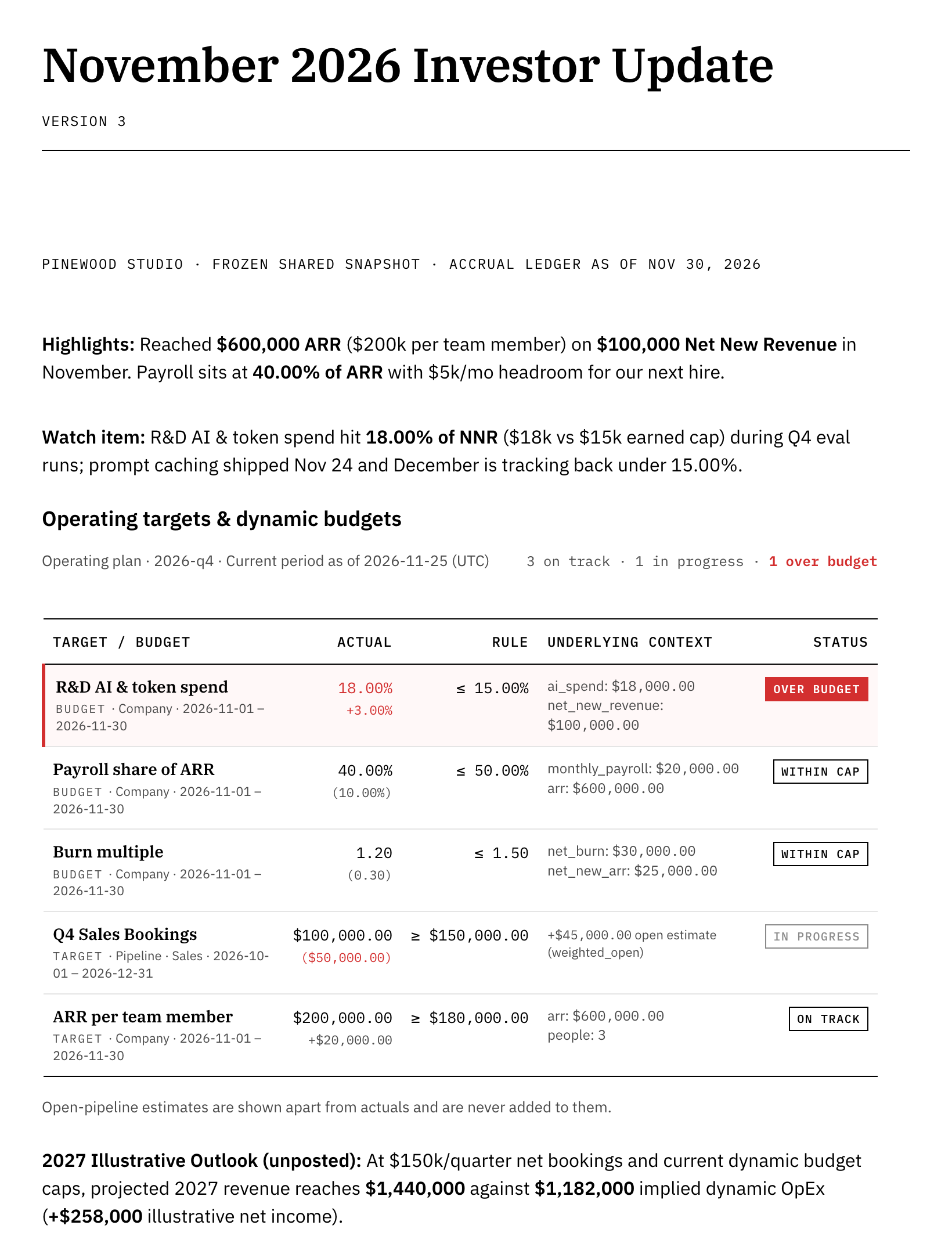
Instead of maintaining a separate budget deck for board meetings, embed a native targets block directly inside a custom report or monthly investor update. Pick an operating plan label or explicit target IDs, preview live actuals beside your financials, and send investors a frozen, revocable shared view that preserves the exact target actuals, underlying context and statuses they saw — without exposing internal SQL or undisplayed future schedules.
When a board still wants a formal annual spreadsheet or a forward projection, ask your agent to project a full what-if P&L directly from your active targets and dynamic budget rates — or export a formal board-budget sheet (Actual, Board Baseline, Current Dynamic Budget, Projected) on demand, explicitly labelled as unposted.
Revise the plan without losing the board baseline
“How do you manage the internal coms if your end of year milestone eventually becomes too disconnected from the quarterly targets and feels completely out of reach? Do you just stop talking about it?”
A Y Combinator founder on the private YC forum
Changing a budget rate — say moving R&D tokens from 12% to 15% of Net New Revenue — records a new immutable target version with who changed it, when and why, with zero SQL edits. Every earlier version stays readable by version number or UTC date, so you can always compare today's books against both the board-approved baseline and the current operating revision. Targets also support a proposed status so an agent can draft a plan and show you the first live read before activating it.
How this compares to spreadsheets, cards and bolt-on FP&A
Founders usually try three workarounds before connecting budgets to their real books:
- Spreadsheets and annual board decks: free on day one, but actuals have to be rebuilt by hand every month, hire-and-replace overlaps stall behind static slots, and mid-year re-forecasts overwrite the original commitment.
- Corporate card limits (Ramp, Brex) and compliance ledgers (QuickBooks, Xero): card tools see swipes, not accrual ARR or headcount; compliance ledgers hold flat GL-code monthly grids detached from pipelines, contracts and customer/vendor terms.
- Standalone FP&A layers (Mosaic, now part of HiBob; Causal, now part of Lucanet; Runway): powerful once a dedicated finance team owns clean ERP, CRM, billing and HRIS connectors, but expensive and slow to implement when the underlying systems do not agree. Economico puts contracts, people, bills, pipelines, real accrual books and dynamic budgets in one underlying data model from the start.
Where this stops
The workspace, MCP App and shared views render targets, dynamic budgets and report target blocks read-only; creating, revising and archiving targets happen through your agent over MCP, REST or the CLI. Dynamic budgets never block recording a real expense that already happened. Spend labels for splitting a single shared expense account (such as conferences across Sales and Marketing), credit splitting for commissions, and interactive multi-scenario ledger overlays (scenario planning) are not in the product yet. Formal spreadsheet exports and what-if P&L projections are generated by your agent from live reads and stay unposted.
Copy & paste into your agent
Connect Economico and set up your first dynamic budgets in one prompt
Paste any prompt below into Claude, ChatGPT, Codex, Gemini, Grok or Antigravity. Each one connects Economico via /skill.md if you are not connected yet and runs straight on your books or a seeded demo company.
Set up Economico per https://economi.co/skill.md (if not connected yet), then propose an operating plan for next quarter using dynamic budgets and targets: burn multiple <= 1.5x, payroll <= 50% of ARR, R&D AI & token spend <= 15% of Net New Revenue, and travel <= $1,000 per employee. Show me the first live read with underlying dollars before activating.
Set up Economico per https://economi.co/skill.md (if not connected yet), then use our trailing 3-month baseline, active sales targets, and dynamic budget caps to show an illustrative unposted P&L for next year if we hit 80%, 100%, or 150% of target — and how many engineers we can hire at each level.
Set up Economico per https://economi.co/skill.md (if not connected yet), then add a native targets block for our current operating plan to this month's investor update report, preview it with actuals and underlying dollar context, and prepare a frozen share link for the board.
Connect your agent
Run on live operating rules, not January guesses
Put your growth targets and dynamic spending guardrails directly over your real accrual books — and check headroom in one conversation.
Go deeper
Learn
Compared with