Built for agents
A system of record your agents can work in on their own
Most finance software is simplified for a person at a dashboard. Agents can hold far more detail than that, so we rebuilt the ledger from first principles: every command, document and posting kept, linked and replayable, with a ledger for every contract and right you agree to.
Recent changes
Agents need something to hang the work on
Point a capable agent at your email, contracts and bank exports and it will find things no bookkeeper would: the discount you promised in a text, the vendor that billed twice, the second version of a contract. Without a system of record behind it, though, it ends up building its own tables, keeping two copies of the same agreement and rebuilding the books on every pass. The agent is capable. It just has nowhere reliable to put what it finds.
The first version of Economico mapped the usual ERP screens onto agent tools. Then we went back to first principles. Accounting software was simplified so a finance person could keep up with it. An agent does not need it dumbed down, so Economico keeps the full structure of each deal and lets the agent work in it directly.
Commands, documents and postings, linked for good
Everything your agent does arrives as a command: record this contract, this invoice, this payment. Each one is checked against your permissions, then kept exactly as it was sent, with a receipt. The documents behind it (the signed agreement, the vendor's PDF, the payment confirmation) are stored byte for byte and linked to the command. The command's effects post to the ledger as one event, which links to the event before it, so the history can be replayed and checked from the start.
Nothing is edited in place. If a contract was entered wrong, you void it or reverse it and record the right version, the way ledgers have always worked. The mistake and its correction both stay in the history, each showing who recorded it.
 Your agent × Economico
Called 4 Economico tools
Economico
subjects · get contract
✓
Acme Cloud service agreement, version 2
Economico
events · list
✓
Three invoices recorded by commands from the agent
Economico
documents · get
✓
Signed order form, kept byte for byte
Economico
ledgers · statement
✓
Revenue and receivable postings for each invoice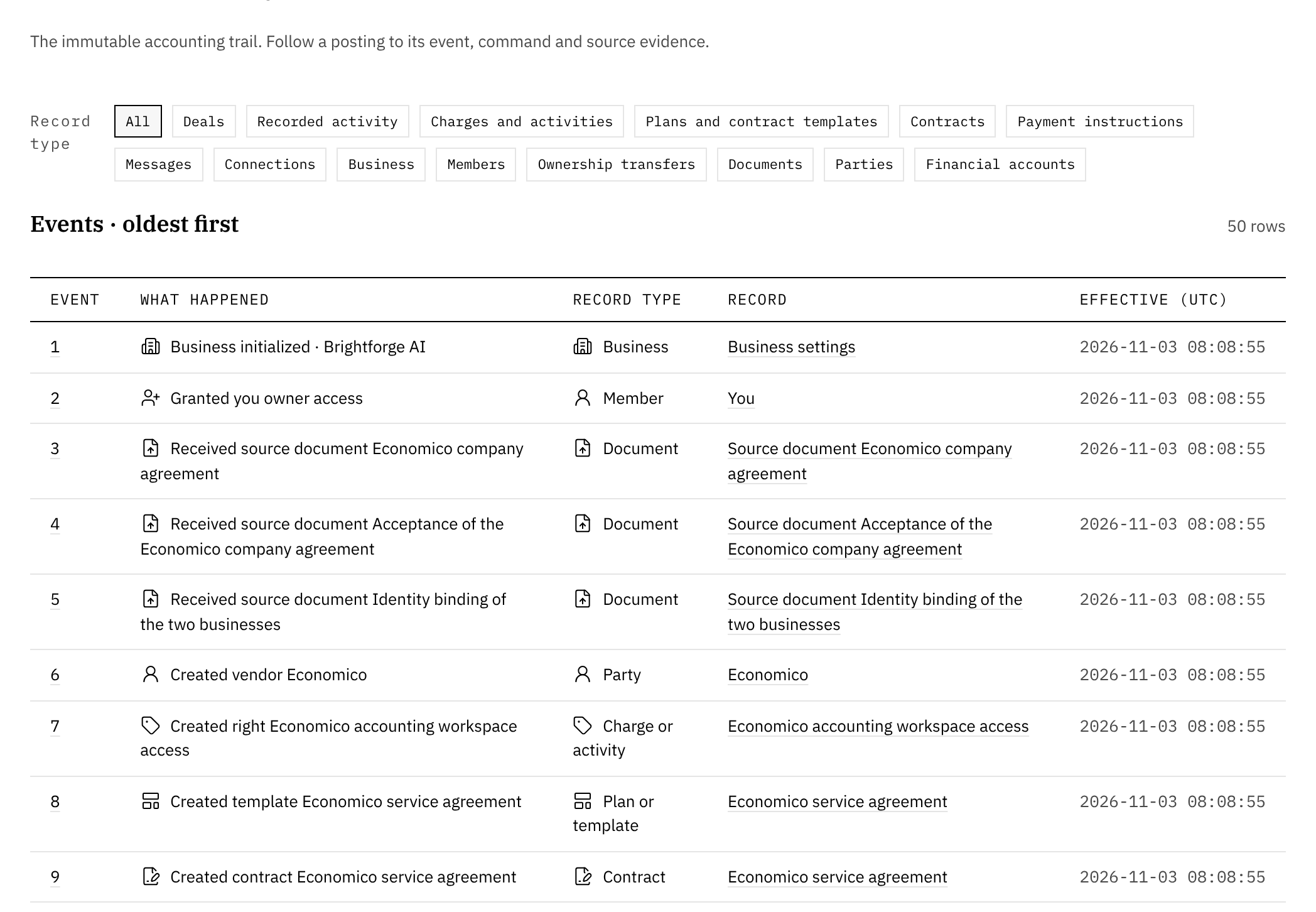
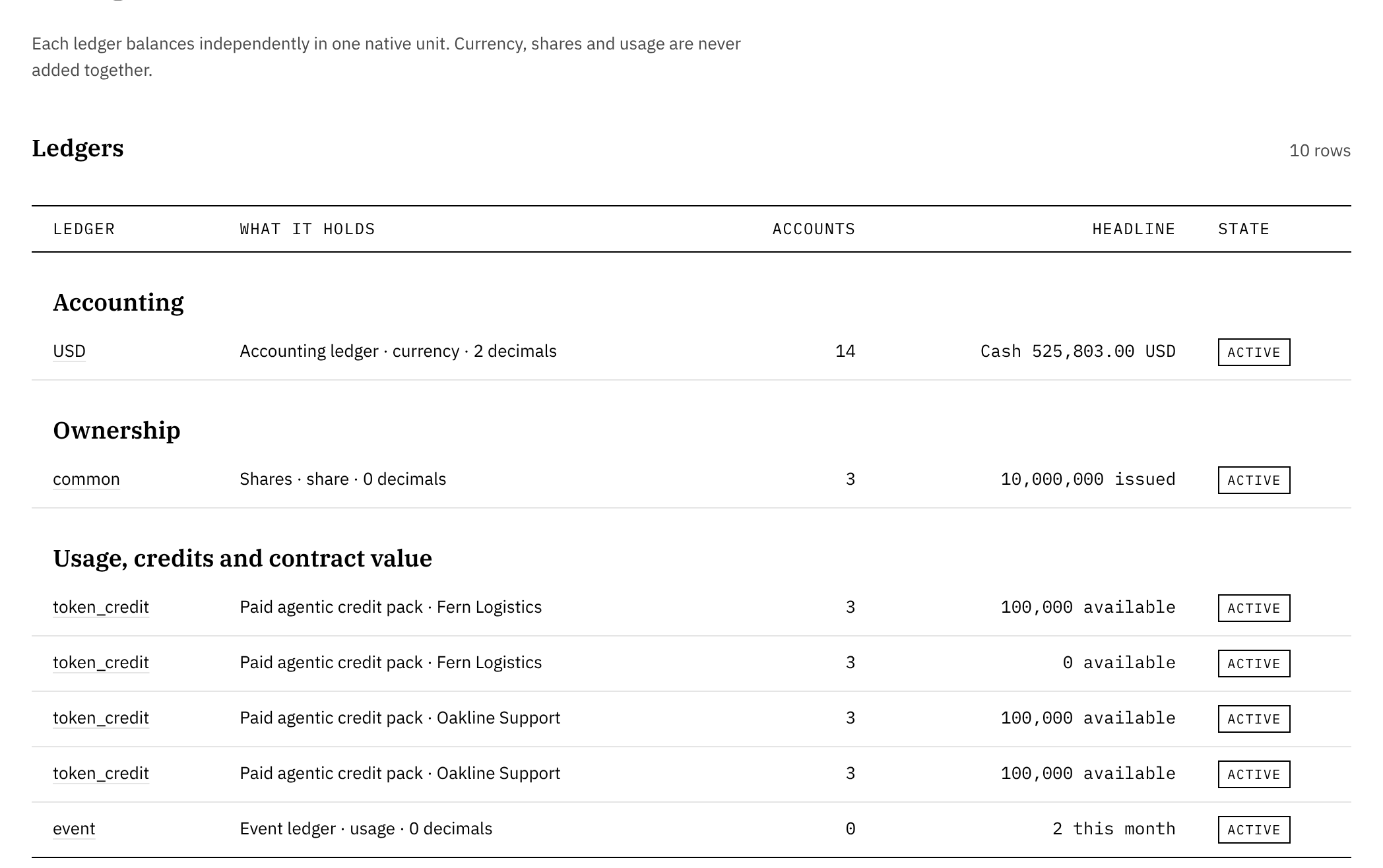
A ledger for every contract and every right
A general ledger alone answers the accountant's questions. It cannot tell you what one customer costs to serve or what a vendor pass-through really earns you. Economico records each contract as the specific rights it grants: the seats, the usage, the allowance, the service. Each right keeps its own ledger in its own unit, beside the general ledger your accountant reads. The same history gives you the books for tax and the detail for unit economics, without a second system.
Your agent does the work; you make the decisions
Economico validates every command before it records anything, but it never decides what a contract means. Your agent proposes, records and explains; you choose the terms, the treatment and the exceptions. Your agent can work through months of history unattended because each step it takes is checked, kept with its evidence and reversible by a later correction, never by deleting anything.
You can check the whole history at any time: verification replays every event and compares the result, and the portable export gives you the full history and the exact source documents to keep. The books belong to your company, not to the agent or to us.
Connect your agent
Give your agents a system of record
Connect the agent you already use and have it record one real contract. Then follow every number it produces back to the command and document behind it.