Performance management
Know you're off plan while there's still time to fix it.
Startups rarely die in one bad month. They miss the plan a quarter at a time, hire against runway they guessed, and find out when the board or the bank balance tells them. Put sales, hiring, the raise and burn on targets inside one underlying data model, and your agent reads where you stand straight from real accrual books.
Recent changes
Most founders find out they missed the plan when it’s too late to fix
“We missed our Q1 target relative to the plan, so the question I have for you is, when you miss a quarter (or two or three :)), do you…”
A Y Combinator founder on the private YC forum
Most finance tools are built for compliance—tax filings and month-end closes—not for steering a company. So the goals you actually run on end up in a deck or a spreadsheet, while the work lives in four disconnected tools: deals in a CRM, candidates in a hiring app, investors in a sheet and money in the books. Every check-in means rebuilding actuals by hand, and the moment the plan changes mid-year, the original numbers vanish.
Economico puts the goal, the pipeline and the real accrual books in one structured record. You set the numbers; your own agents do the reading—and tie plan checks into whatever custom reporting workflows you build around your company.
Why this matters to me
Board reporting always came first at the company I ran, and the plan we reported against lived in a model that had five owners over the years. Every time someone asked how we were doing against plan, somebody rebuilt the actuals from exports. I want the plan and the actuals to come from the same place, so the question takes one read.
 Pelle BrændgaardFounder, Economico
Two pieces that work alone—and better together
Pipelines model the process. Define as many as your business needs—enterprise sales, self-serve upgrades, engineering hires, your seed round or a vendor search—each with its own stages and weights. A pursuit is won only when the signed agreement or employment arrangement lands in the books.
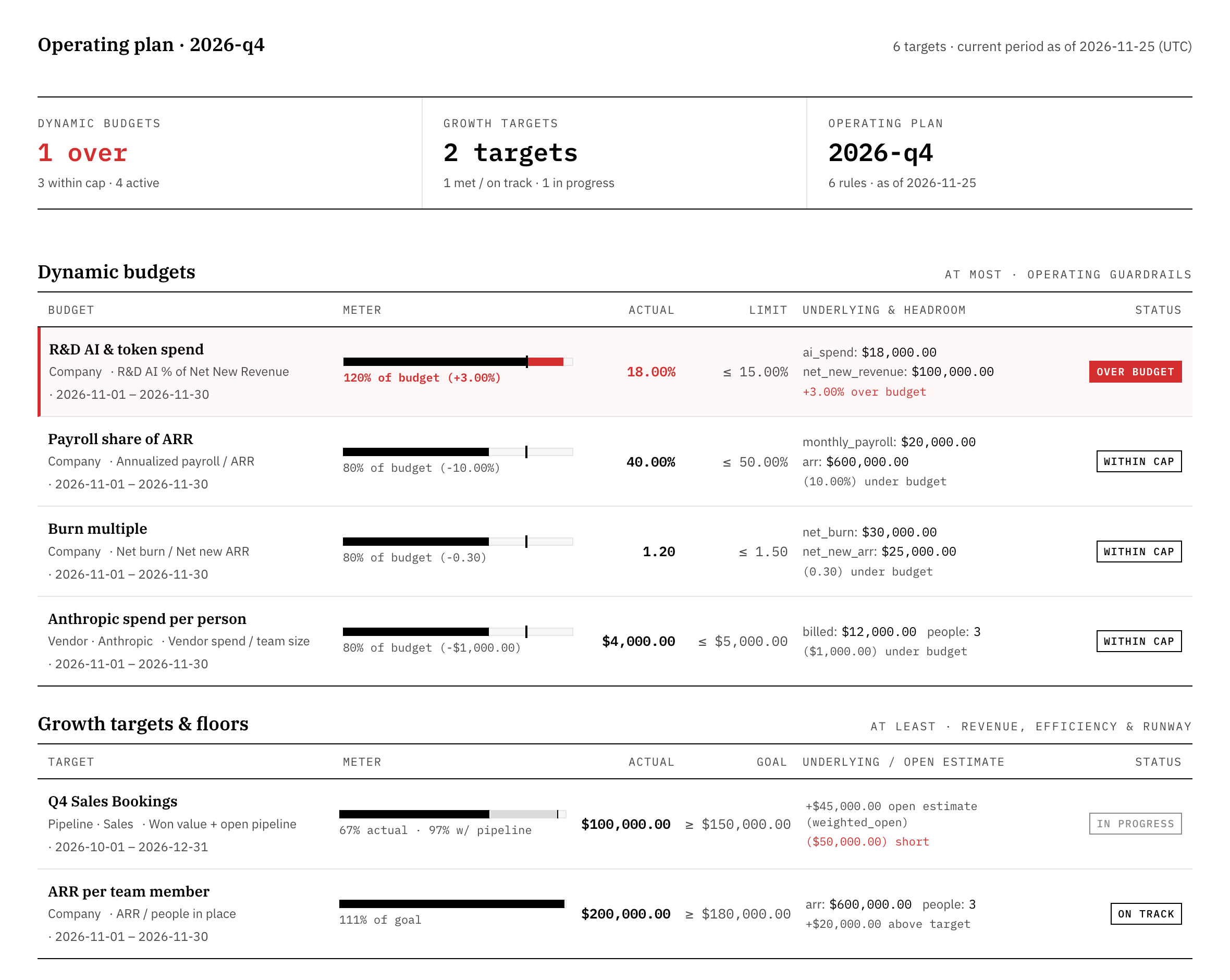
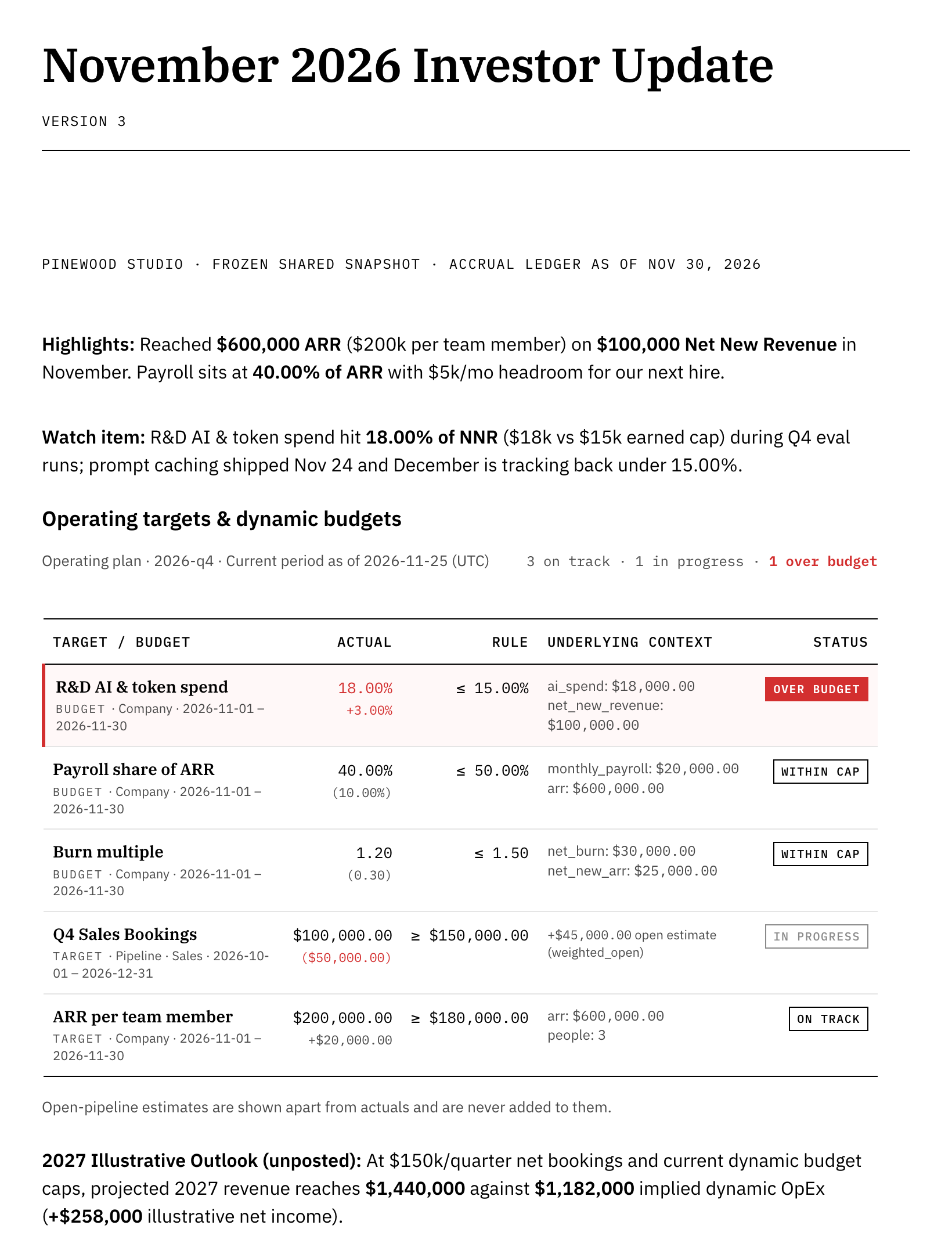
Targets and dynamic budgets state the numbers and guardrails. A target holds one pipeline, one person (a quota), one vendor, one customer or the whole company to period-by-period goals and spending caps measured straight from the books: hires won, won deal value, ARR, monthly net burn, burn multiple, payroll share of ARR, R&D AI spend as a percentage of Net New Revenue, travel per employee, or a custom SQL measure your agent writes — with the underlying dollars shown beside every ratio. Group targets under a plan label and they become your operating plan, rendered directly on your overview, pipeline boards, party pages and inside native targets blocks in saved custom reports and frozen investor links.
Put a target on a pipeline and one read answers the real founder question: where are we against plan, and does open pipeline cover the gap?
 Your agent × Economico
Called 4 Economico tools
Economico
targets · list
✓
9 active targets with plan = 2026-q4
Economico
targets · read
✓
Hiring: October met, November in progress
Economico
targets · read
✓
Won customer value: October met, November in progress
Economico
targets · read
✓
Net burn and payroll cost: October under the limitWhat you can run this way
- Sales. Won deals and won value per quarter, held by each sales pipeline, with weighted open pipeline beside the actual. A quota for one person is a target held by that person. Read more
- Hiring. A one-off hire for a role, or a monthly ramp held by the hiring pipeline, next to people in place and payroll cost. Read more
- Fundraising. The round as a pipeline of investors, with a target for capital committed by a date. Read more
- Vendor selection. A shortlist of vendors moving to a signed agreement, held to a decision date. Read more
- The company plan. ARR, MRR, cash and net burn targets grouped as one operating plan, read against both the original and revised numbers. Read more
- Partners and advisors. Any relationship that ends in an agreement can be its own pipeline, with its own target.
The rules that keep it honest
- Progress is read, never typed in. Actuals come straight from your books every time a target is read. Nobody edits a status column.
- Estimates never pollute the ledger. Deal values, stage weights and targets change no balance, revenue or cash figure. Weighted open pipeline sits beside the actual and never counts toward it.
- Earlier versions stay intact. Revising a target records a new version with who, when and why—so you can always compare today against the plan the board originally approved.
- Your agent proposes, you decide. New targets start as proposed unless you stated the numbers yourself. You confirm them before they go live.
What it does not do yet
You can inspect every pipeline board, target and operating plan in the workspace, read-only; all writes go through your agent over MCP, REST or the CLI. A target read returns the stated value, actual, gap and status per period; pace and coverage ratios are calculated by your agent with its assumptions stated. Splitting deal credit between people, commissions and bonuses are outside scope, and disposable what-if overlays are planned separately in scenario planning.
Copy & paste into your agent
Connect Economico and ask for the plan and progress in one breath
Paste any prompt below into Claude, ChatGPT, Codex, Gemini, Grok or Antigravity to connect via /skill.md and run straight on your books.
Set up Economico per https://economi.co/skill.md (if not connected yet), then propose targets and dynamic budgets for next quarter: two engineering hires, $60,000 in new annual contracts, payroll <= 50% of ARR, and net burn <= $45,000 a month. Label them under one plan for next quarter and show me the first live read before activating.
Set up Economico per https://economi.co/skill.md (if not connected yet), then read every target and dynamic budget in our current operating plan. Show which are over budget or behind, with underlying dollars, and whether weighted open pipeline covers the gap.
Set up Economico per https://economi.co/skill.md (if not connected yet), then revise our hiring target for the rest of the year, keep earlier months at the board baseline, and record the reason on the new version.
Connect your agent
Start with the one number you check every week
Move the target you track in a spreadsheet today into Economico and read it back live from your books.
Go deeper
Learn
- Your startup budget became board compliance. Here is how to run on live rules instead.
- You missed Q1. Now the plan you showed the board is fiction.
- You'll miss the quarter, and your CRM won't warn you
- You hired against runway you guessed
- A hundred investors in a spreadsheet, and you still don't know what's signed
- The vendor contract renewed while you were still comparing quotes